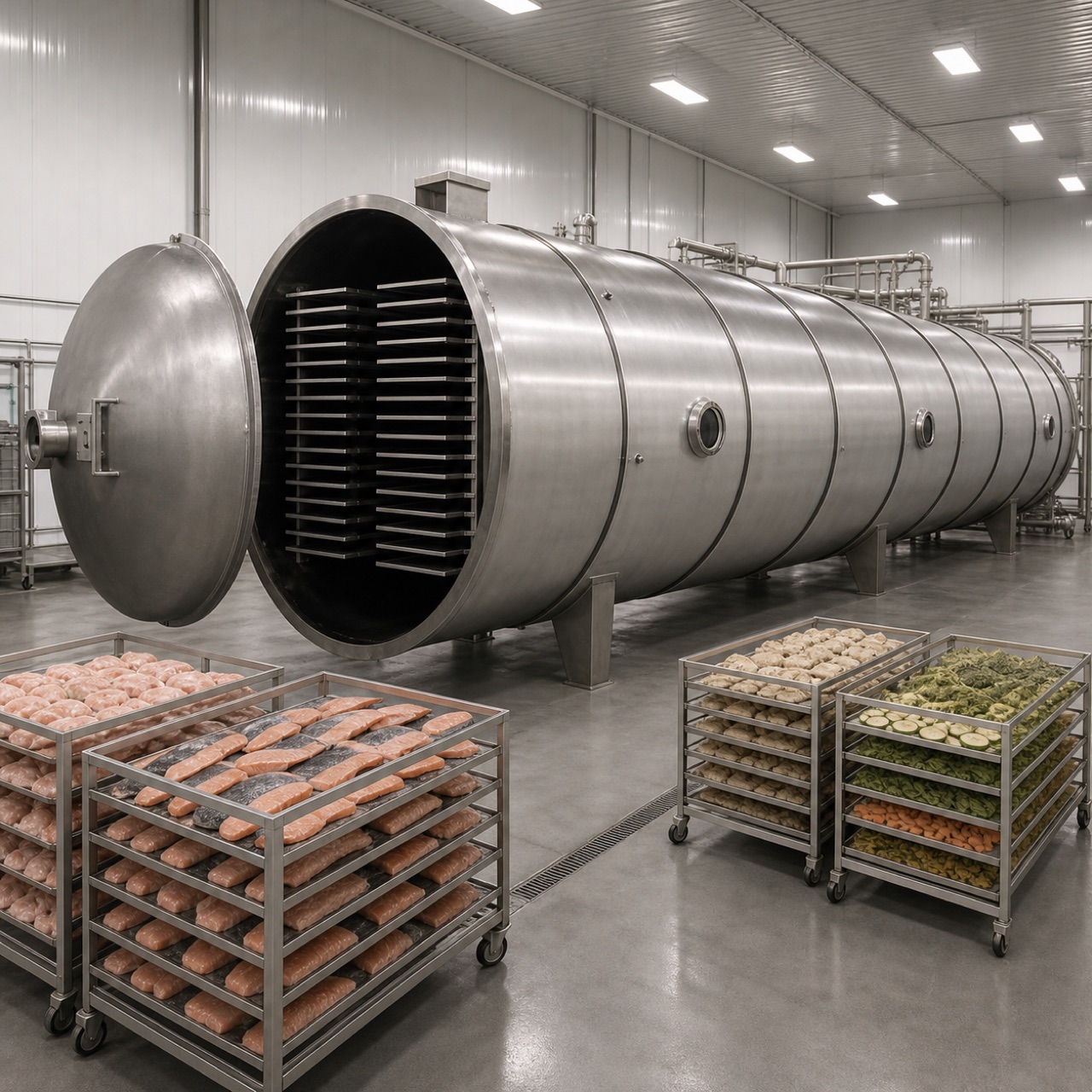
Protein products can look straightforward on a tray, but moisture, fat, piece density, raw or cooked status and sanitation change both the process and the equipment decision. FreezeCraft focuses on proving the product first, then handing a measured loading and packaging basis to the industrial team when demand justifies FFD scale.
Equipment and application views
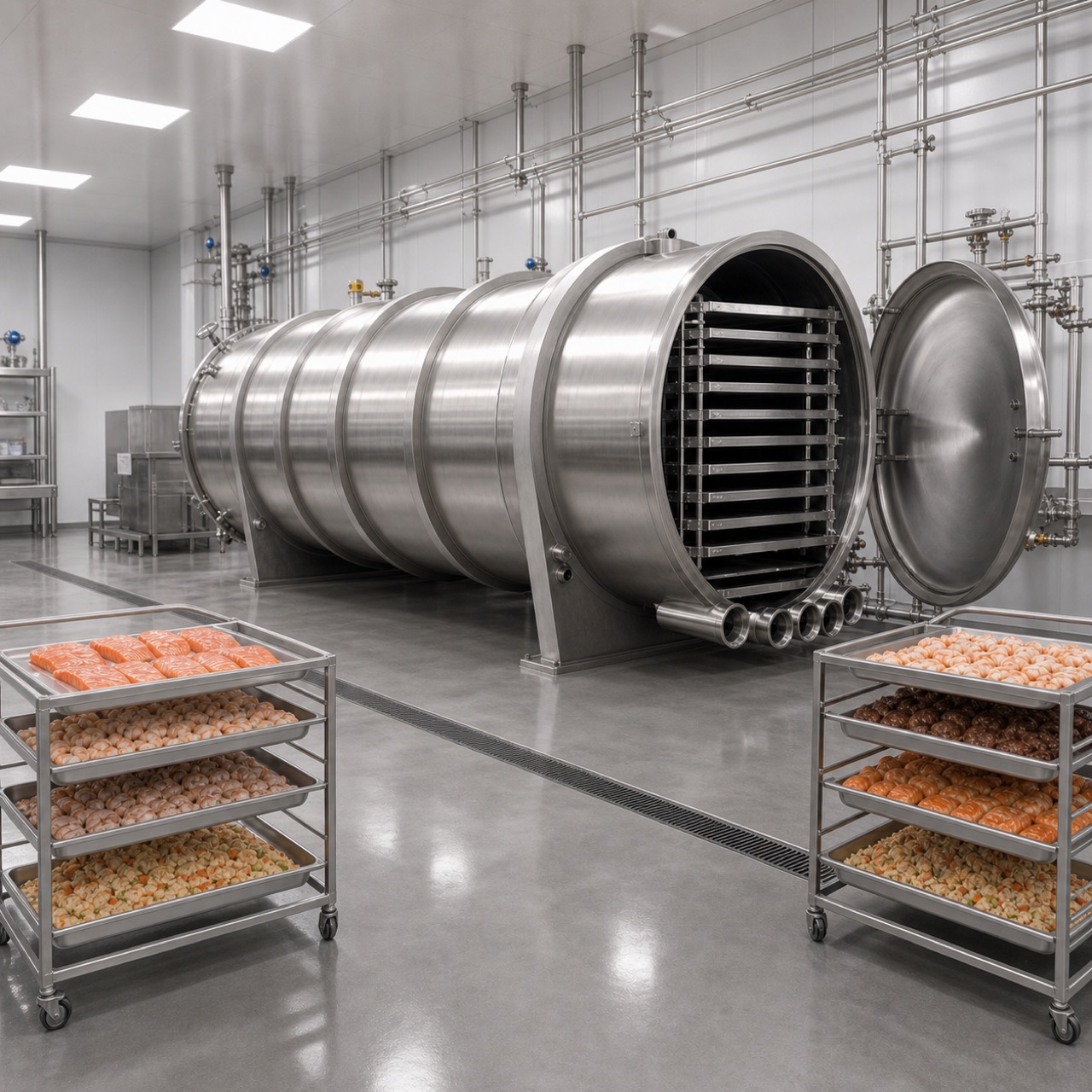
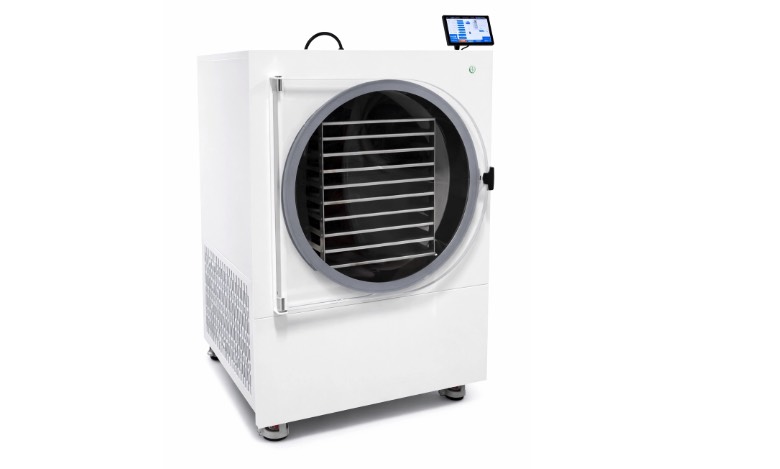
Prove one product before mixing a family
Choose one species or formulation, raw or cooked status, piece dimension and tray depth. Record incoming weight, moisture or solids where available, kilograms per tray, pre-freezing condition, cycle version, finished weight and endpoint check.
Lean fish, fatty fish, organ, cooked meat and formulated pet treats should not be assumed to share one cycle. A clear baseline makes later comparisons useful.
Treat food safety as a separate control plan
Freeze drying removes water under vacuum; it should not be assumed to be a universal pathogen kill step. Define supplier, raw/cooked separation, time-temperature controls, sanitation, traceability and release requirements for the intended market.
For raw protein products, obtain the qualified food-safety review and validation required by the business and jurisdiction. The freeze dryer supports the process but does not replace it.
Control what touches every tray
Set an acceptable piece-size range and weigh each tray. Avoid unrecorded overlap or deep piles. For minced products, sauces or formulations, control fill depth and shape so the slowest center can be evaluated.
Map tray positions and keep representative samples from edge and center locations. A dry surface can conceal a wetter core.
Package around fat as well as moisture
Stage barrier pouches and the sealer before unloading. High-fat fish, meat or organ products can require stronger oxygen and light protection than a low-fat fruit snack.
Record unload-to-seal time, package construction, seal settings and any validated oxygen-control method. Shelf-life claims need a product-specific study under the intended package and storage conditions.
Know when the small machine is no longer the bottleneck
A larger machine is justified only after the recipe, loading, sanitation and packaging are repeatable and sales demand cannot be served by the current weekly schedule. Measure whether preparation, pre-freezing, drying, cleaning or packaging is the true constraint.
Use commercial trials to calculate kilograms per square meter, water to remove and complete turnaround. Those values form a better industrial RFQ than an optimistic fresh-load target.
Hand a measured package to the industrial team
For FFD scale-up, send product and formulation, moisture and fat, prepared kilograms per batch and day, piece dimensions, kilograms and depth per tray, pre-freezing, target endpoint, sanitation, package and available utilities.
ArcticDry ADT-500I and larger models map to SJ-FFD cylindrical industrial platforms. Final equipment selection adds carts, condenser margin, utility peaks, loading lanes and full-batch packaging to the commercial evidence.
Frequently asked questions
Does freeze drying make raw pet food pathogen-free?
Do not assume so. The producer needs a product- and market-specific food-safety plan with validated controls beyond water removal.
Can fish, meat and organ use one recipe?
Not automatically. Composition, fat, piece size, freezing behavior, endpoint, odor and cleaning can differ and should be studied by product family.
What data is most useful for industrial scale-up?
Measured kilograms and depth per tray, removable water, complete turnaround, sanitation, packaging rate and the daily production target are more useful than chamber volume alone.
This page provides general engineering and operating context. The model-specific manual, approved site procedure, technical agreement and product validation take priority.